

The Monarch Model™
Lived Experience as Strategic Intelligence
A framework for operationalizing lived experience as the driver of human agency in healthcare innovation.
By Erica V. Olenski, BCPA, CPXP, eFACHDM — Founder & Principal Strategist, Monarch Futures
Executive Summary
IN BRIEF
● Lived experience is strategic intelligence: it reveals the determinants of agency that dashboards, personas, and journey maps cannot.
● Human agency — the practical capacity to understand, decide, and act — is the mechanism that connects organizational investment to human outcomes.
● Artificial intelligence, value-based care, and consumerization make designing for agency both a moral and an economic imperative.
● The Monarch Model turns lived experience into measurable design inputs through intentional listening, governed so value returns to its source.
Healthcare has embraced human-centered care and patient-centered innovation and now requires a framework that turns those principles into operational practice. The Monarch Model™ provides that framework. The Monarch Model positions lived experience as strategic intelligence and human agency as the organizing principle for healthcare design, implementation, governance, and evaluation. Human agency is the mechanism that connects organizational investments in physical, social, and intellectual capital to human outcomes.
Lived experience is strategic intelligence because it reveals the conditions that shape healthcare within real human lives. Through intentional listening, lived experience reveals the determinants of agency: the conditions that determine whether people have the practical capacity to understand, decide, and act within healthcare. Yet healthcare rarely measures the conditions that make agency possible.
Healthcare has long relied on abstraction to understand people and guide innovation. Personas, journey maps, demographic profiles, and archetypes organize information about people, but they cannot reveal the determinants of agency. The Monarch Model shifts healthcare from measuring people to measuring the conditions that shape human agency. The Monarch Model makes strategic intelligence actionable by transforming the determinants of agency into measurable design inputs.
One of the most influential determinants is the state of the human nervous system. Agency depends on a nervous system that can learn, decide, remember, and act. Safety is both a design requirement and a clinical objective.
The Monarch Model applies to every person who participates in healthcare because every participant is influenced by determinants of agency. Patients, caregivers, clinicians, therapists, administrators, policymakers, researchers, executives, innovators, and payers experience healthcare through different roles, but the human conditions that shape agency stay constant. Although the roles and responsibilities may differ, the human conditions do not.
Healthcare organizations create value by investing in three forms of capital: physical capital, social capital, and intellectual capital. The Monarch Model evaluates how effectively these investments strengthen the determinants of agency and expand human agency through friction. The Monarch Model organizes strategic intelligence through four connected gears that illustrate how lived experience becomes organizational capital through operational practice. The model relies on intentional listening to generate strategic intelligence and on governance to keep that intelligence accountable to the lives from which it is generated and the value it is intended to create.
Healthcare stands at a defining inflection point. Artificial intelligence is becoming embedded throughout healthcare delivery, and the assumptions organizations build into solutions today become the assumptions AI scales tomorrow. At the same time, value-based care increasingly rewards outcomes shaped by the determinants of agency, and health consumerism puts more decisions in the hands of the people who live with their consequences. Together, these forces create an opportunity to establish human agency as the foundation for the next generation of healthcare innovation.
Designing for human agency is a moral and economic imperative. Organizations that measure the determinants of agency build innovations people can understand, adopt, trust, and sustain. Organizations that expand human agency strengthen outcomes, protect investment, and maximize value. The Monarch Model provides the framework for designing the next era of healthcare innovation around real human lives. Healthcare innovation that expands human agency advances human well-being.
Glossary
The core concepts and vocabulary that recur throughout this paper, defined in brief.
Lived Experience
Lived experience is the firsthand reality of how healthcare is experienced, navigated, and functions within human lives.
Human Agency
Human agency is the ability of a person to understand, decide, and participate meaningfully in the decisions that shape their life.
Determinants of Agency
The conditions that determine whether people have the practical capacity to understand, decide, and act within healthcare.
Human Nervous System
The biological system that continuously detects, interprets, and responds to cues of safety and threat in the environment, shaping attention, learning, decision-making, memory, and action.
Physical Capital
The accumulated value embodied in the physical and technological infrastructure that enables healthcare delivery.
Social Capital
The accumulated value embodied in relationships, communication, trust, behaviors, and cultural norms that shape how people experience healthcare.
Intellectual Capital
The accumulated value embodied in clinical knowledge, evidence, standards, and organizational learning that informs healthcare decisions and innovation.
Friction
The resistance, or lack thereof, that occurs where lived experience engages physical, social, or intellectual capital.
Intentional Listening
The practice of gathering, interpreting, and validating stories, observations, and lived experiences through a spectrum of methods and channels to understand the comprehensive human context surrounding healthcare decisions.
Governance
The structures, practices, and responsibilities that preserve integrity, accountability, and responsible action where they are not inherently ensured by systems, incentives, or market forces.
Understanding Determinants of Agency
Why healthcare’s habit of premature abstraction fails the people it is built to serve, and how informed consent already began the work of measuring agency.
Healthcare innovation has a persona for almost everyone. Before a product launches or a workflow is designed, a hypothetical person is sketched in a meeting, given a name, an age, a set of goals, and a journey that unfolds in orderly stages. Personas are useful. They are also consequential. The moment a persona is created, the most important design decision has already been made: who this innovation is for, what that person carries, and what matters to them.
Everything designed inherits assumptions from the persona, from the metrics and messaging to the design and architecture. Whatever a real person carries that the persona did not anticipate has nowhere to exist. It is not weighed and set aside. It is excluded before the design work even begins. What the persona removes is not detail. It is the lived reality through which a person encounters every intervention built for them. As a later section will show, a design that begins with a persona can move quickly and still fail to connect with the life it was meant to serve.
The root failure of the persona approach is not a shortage of empathy or input. It is premature abstraction: generalizing about people before understanding any one person’s life. Healthcare reaches for the general before it understands the realities of individual lives because abstraction is faster, cleaner, and easier to operationalize. What can be abstracted can often be measured, and what can be measured tends to receive attention. Yet many of the determinants of human agency never enter the systems that guide decisions. Their absence rarely appears on a dashboard or a balance sheet. It becomes visible only when a real person encounters the design.
Human agency is the ability of a person to understand, decide, and participate meaningfully in the decisions that shape their life. Human agency is not separate from well-being. Human agency is one of the conditions from which well-being emerges [1]. Healthcare exists to improve well-being, but well-being cannot be reduced to clinical outcomes alone. It also depends on whether a person can understand, influence, and participate in decisions about their care. Agency is expressed through choices, constraints, trade-offs, relationships, and the ordinary conditions of daily life that the systems built to serve people often fail to recognize.
Determinants of agency are the conditions that determine whether people have the practical capacity to understand, decide, and act within healthcare. The practice of medicine has been measuring the determinants of agency for more than seventy years. It built an instrument to do it: informed consent [2]. Every informed consent process asks the same questions: Did the person understand what was proposed? Did they have the capacity to decide? Was the decision made voluntarily? Understanding, capacity, and voluntary participation are foundational determinants, expressed in the language of an earlier era and embedded in the law, ethics, and accreditation standards that govern healthcare [3]. Informed consent is not merely a procedural formality. It is healthcare’s clearest acknowledgment that a person’s ability to participate in decisions about their own care is a condition of legitimate care itself.
And yet informed consent reaches its limits at precisely the moment it matters most. Consent is assessed once, at the point of signature, through a process that often serves institutional legal obligations alongside its purpose of informing patients. It is presented to someone whose nervous system has already narrowed under fear, pain, uncertainty, or exhaustion. Nothing in that encounter systematically assesses cognitive load, media literacy, health literacy, financial strain, or caregiver capacity, even though these conditions often determine whether the person understood anything at all. Every clinician who has handed a consent form to a frightened family knows that a signature does not necessarily reflect comprehension. The Monarch Model does not replace informed consent. It extends the work informed consent began by treating the determinants of agency as conditions to be understood, measured, and intentionally designed for throughout the course of care, rather than assessed once and left unexamined.
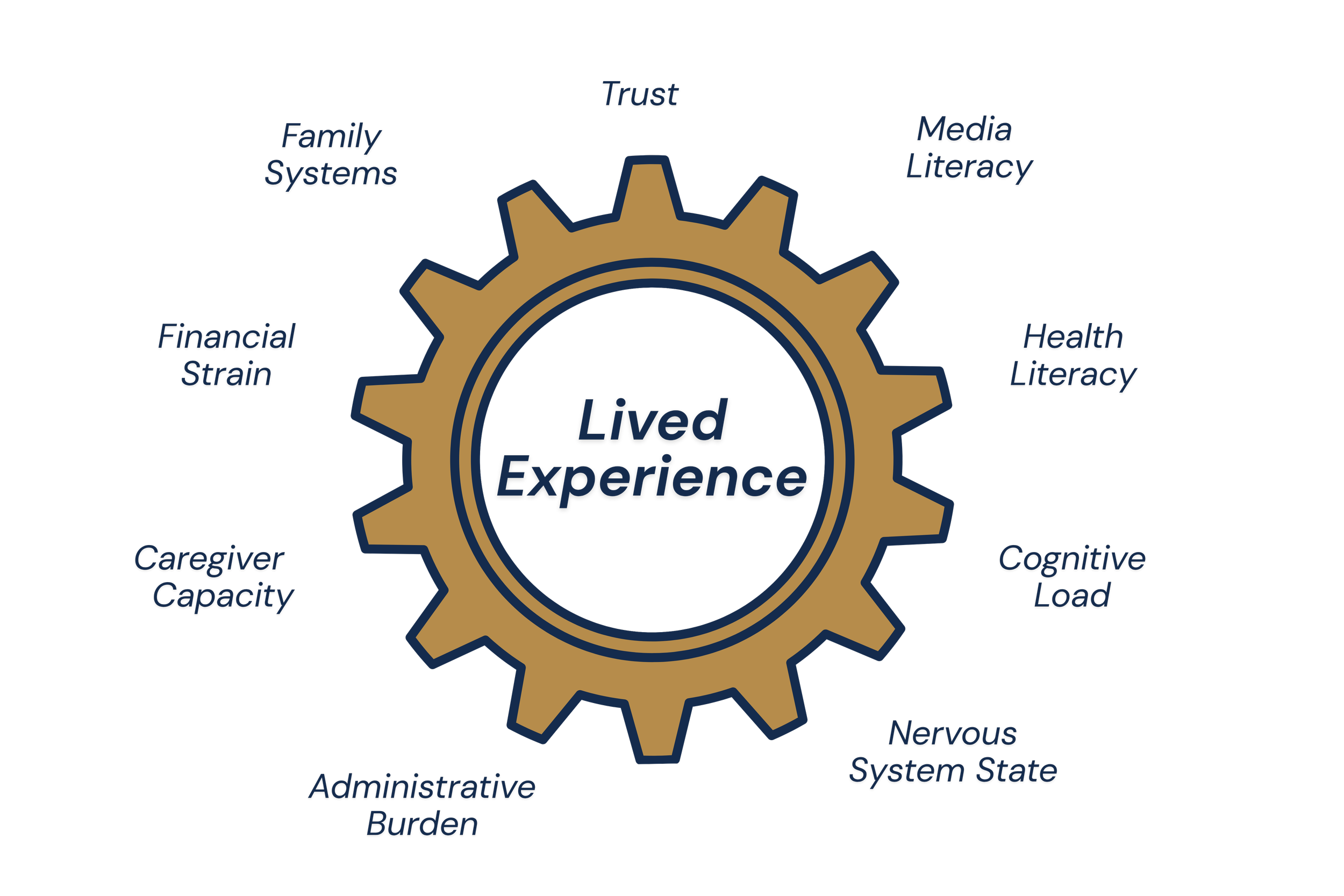
Examples of determinants of agency that help add definition to lived experience.
Source: The Monarch Model™, Monarch Futures analysis.
Exhibit 1. The determinants of agency give lived experience its definition — and make it measurable.
● Center: Lived Experience
● Determinants of agency arranged around the gear: Trust; Family Systems; Media Literacy; Health Literacy; Cognitive Load; Nervous System State; Administrative Burden; Caregiver Capacity; Financial Strain
Some determinants of agency are routinely measured, although many are not. Trust, caregiver capacity, administrative burden, health literacy, financial strain, transportation, language, cognitive load, and social support all shape a person’s ability to participate in care, yet many remain largely invisible in practice. Each is a point of contact where something of value an organization builds engages with a human life. For example, financial strain influences human agency because its effects begin long before a bill arrives, in what a person quietly stops asking for, stops questioning, and stops imagining as possible. This disengagement shows that what is not registered cannot be intentionally designed for. Patient and caregiver stories are records of where systems support human agency and where they quietly diminish it. They capture the burden, friction, and adaptation of everyday life that no dashboard can fully represent, including those sophisticated enough to measure the clinically recognized social determinants of health. More importantly, they reveal the determinants of agency that often remain invisible to the systems used to allocate attention, resources, and investment.
Lived experience is the firsthand reality of how healthcare is experienced, navigated, and functions within human lives. It reveals realities that organizations depend on but rarely measure, and what goes uncounted is often excluded from strategy, investment, and design. The distinction matters because innovation built without lived experience risks more than inefficiency. It risks producing products, services, and systems that are harder to navigate, less responsive to the realities of human lives, and ultimately less capable of delivering the value they were designed to create.
Consider the caregiver who carries a binder, or keeps an entire medical history in memory, repeating it from the beginning to every new clinician who walks through the door. That caregiver is the connective tissue between systems that do not speak to one another, performing by hand the integration that technology promised but has yet to deliver. That invisible labor shapes the caregiver’s agency. It determines how much time, attention, confidence, and emotional capacity remain for everything else that care demands. For many families, administrative labor is the patient experience itself, even though it often remains invisible to the people who design the systems because they have never had to carry it and only experience the consequence of it. In that sense, the caregiver experience is the patient experience.
The Monarch Model begins with the opposite instinct. Rather than beginning with abstraction, the model allows generalization to emerge only after engaging a real, complex, irreducible human life. Healthcare is being asked to do more than understand people. Healthcare is being asked to protect and expand human agency because agency increasingly determines whether innovation creates the value it was intended to deliver.
Recognizing that human agency has determinants changes what agency is. Agency stops being an outcome to hope for or a philosophical ideal to invoke. Agency becomes something leaders can identify, assess, and intentionally design for. Innovation can then be evaluated by a simple question: does it expand a person’s agency, or diminish it?
Healthcare has always depended on human agency. Artificial intelligence has made human agency and governance far more consequential. Agency in the age of artificial intelligence increasingly depends on who controls a person’s data. As more of a person’ life becomes information that others collect, combine, and act upon, whether that person remains a participant in the decisions made from those data becomes a defining condition of agency. The terms governing that participation are established through policy and data governance. Data governance is therefore not a peripheral technical concern. It is a foundational question of human agency. Large language models can now derive strategic intelligence from lived experience at a scale previously impossible, making sound governance not merely desirable, but essential.
In an economy that increasingly ties value to outcomes, and where those outcomes originate in lived experience, the value created from lived experience should be directed back toward its source rather than remain with whoever happens to hold the data. A system that derives value from lived experience without returning value to its source treats that experience as an extractive resource rather than a reciprocal relationship. Over time, that weakens both the integrity of the data and the agency of the person from whom it was drawn. Governance is the structures, practices, and responsibilities that preserve integrity, accountability, and responsible action where they are not inherently ensured by systems, incentives, or market forces. Governance, in the Monarch Model, is the mechanism that directs value back toward the people who sourced it.
Value settles wherever the data settles when left to its own incentives, while the person whose life produced it has little influence over how that value is created, used, or shared. In a healthcare economy approaching one-fifth of the United States economy [4,5] and still growing, the terms under which lived experience becomes data may become one of the most consequential determinants of human agency the system will establish.
Another often overlooked determinant of agency is the state of the nervous system a person brings to an encounter. Stress, trauma, grief, pain, cognitive overload, and uncertainty fundamentally shape how people process information [6], assess risk, remember instructions, and make decisions. Agency changes as the nervous system changes. The question is no longer whether the nervous system matters. The question is whether healthcare is designed for the nervous system people have.
Designing for the Nervous System Humans Have
Safety is not an accommodation for the sick. It is the precondition for anyone to comprehend, decide, and act, and a strategic design principle in its own right.
Design is almost always for a human being, and a human being experiences a nervous system before they experience their identity as a user, a patient, a member, a provider, or a customer. Lived experience is not a special category of input reserved for one population. Lived experience is the fundamental condition of being human inside a system, and everyone carries it. In healthcare, lived experience surfaces most acutely in patients and caregivers. Of course, they are not the only ones who hold it, but they hold it at an intensity that is impossible to ignore.
Healthcare itself has become one of the stressors it asks people of all identities to carry. The system is complex, high stakes, and exhausting to navigate, and most people arrive already strained, engaging from a state of hypervigilance rather than from any real sense of safety and security. For example, a person living through serious illness, or caring for someone who is, knows this state intimately. When experiencing hypervigilance, attention narrows, and capacity is often spent before the day begins. Trust is already strained.
Most healthcare technology is built as though the end user arrives calm, rested, and unburdened, with the patience to learn a new interface and the executive function to follow a multi-step process correctly the first time [7]. The mismatch is not an edge case, but the ordinary condition of the people the system most needs to reach. The same dysregulation, in a less visible register, runs through clinicians and administrators too, who carry chronic load on the same strained nervous systems and are asked to absorb still more.
Designing for the nervous system human beings have rather than the one the product or service imagines is not an accommodation made for the sick. It is realism, and a prerequisite for agency, because a person cannot meaningfully engage in decision making, process information, or act on a recommendation when the system assumes a cognitive and emotional capacity that is not available to them. This is also where the Monarch Model accounts for a person’s own capacity, what economics would call human capital, not as a fixed quantity to be measured but as a real and shifting condition to design for. The same realism serves the workforce alongside the patient and the caregiver, because the depleted nervous system on the clinician’s side of the encounter is just as real and just as influential to health outcomes.
Safety is the minimum condition for human-centered design and is the first thing a design has to establish before it asks anyone to comprehend, decide, or act. If the systems meant to serve people cause them harm, the design has failed. The Monarch Model borrows this sequencing, with attribution and with intention, from the clinical discipline of trauma recovery. In Judith Herman’s triphasic model (Trauma and Recovery, 1992) [8], recovery moves in order: safety and stabilization must occur first, then the work of processing, then reconnection and integration into daily life. The point is not that a product or service performs therapy. Instead, the sequence required for trauma recovery is also sound logic for design. A solution should establish safety first, so a depleted nervous system can use it, then support understanding, then support reconnection and agency. A solution earns engagement only once it has established safety; that is the foundation the rest is built on.
The same logic that puts safety first also decides what a system is accountable for. Patient outcomes are the performance measure that everyone else who touches the system is judged against. Therefore, the system is accountable for everything that shapes those outcomes, not just the parts it chooses to measure. Caregiver capacity, nervous-system strain, and the conditions a family carries into care are inputs that shape both patient and caregiver outcomes. To hold an organization accountable for an outcome while ignoring what produces it is to measure a result while designing apart from its cause. Designing for the human nervous system is an honest thing to do, and it is also a strategic design principle that can ensure a solution achieves its greatest value. The human nervous system is the biological system that continuously detects, interprets, and responds to cues of safety and threat in the environment, shaping attention, learning, decision-making, memory, and action. A person who engages from security rather than hypervigilance can absorb information, follow a plan, catch a problem early, and stay in their own care. A system where patients, caregivers, and clinicians all operate from that footing is a system that works better, and one that produces better outcomes, including the patient outcomes everyone answers for. Safety is not the cost of doing right by people. It is the condition under which the system and its solutions deliver value at all. Design for the most strained nervous system, and the design serves all the others.
Lived experience reveals what systems miss. The determinants of agency explain why those omissions matter. Designing for the nervous system people have turns those insights into practical action. Ultimately, healthcare innovation should be judged first by whether it expands or constrains human agency. Every other measure of value depends on that answer.
The Stakes Have Changed
Artificial intelligence, value-based care, and consumerization are converging on a single reality: human agency now determines whether innovation delivers the value it was designed to create.
Innovating without lived experience has always carried a cost, and that cost is increasing. Three transformations are reshaping healthcare simultaneously: artificial intelligence, value-based reimbursement, and the growing consumerization of care. Each is a different kind of shift, one in technology, one in economics, one in behavior, and all three converge on the same reality. Human agency is becoming more central to both well-being and organizational success.
KEY FIGURES
● $18B — U.S. healthcare AI investment in the first half of 2026
● ~46% — AI’s share of all healthcare venture investment
● ~20% — projected 2026 share of U.S. GDP spent on healthcare
The first transformation is artificial intelligence. AI is increasingly shaping what encounters are documented in the chart, what care is recommended, what resources are allocated, what risks are prioritized, and what information reaches patients and clinicians. These systems are built to support decision making, and they can only work with the conditions and patterns they are trained to recognize. A model developed without lived experience is trained on a version of healthcare in which the actual circumstances of people’s lives are absent. The result is not only inaccurate recommendations. It is the scaling of assumptions about human behavior that were never grounded in human experience to begin with. The persona once drawn in a conference room was always a risk; the persona embedded in a foundational language model is that same risk, operationalized at scale and woven into the infrastructure of care.
The scale of that exposure is no longer hypothetical. In its H1 2026 Healthcare Investments and Exits report, Silicon Valley Bank found that venture investors directed nearly $18 billion into healthcare AI across the United States and Europe in 2025, roughly 46 percent of all healthcare investment [9], approaching half of every venture dollar entering the sector. Those assumptions are now being capitalized and scaled at a magnitude the field has never seen, at precisely the moment they most need to be grounded in how people live.
The direction that capital travels is its own signal. Investment concentrates where it meets the least resistance, and in healthcare that means the back-office and revenue-cycle systems, the tools that face the least clinical scrutiny and carry the lowest perceived risk. The money flows, predictably, toward the AI that sits farthest from the patient, because that is the easiest place to put it. This pattern reflects a failure of access: capital reaches the edge of the system that was never difficult to serve, still touching the patient experience, but stopping short of the lived experience at its center.
Prior authorization shows how misleading “farthest from the patient” can be. Filed under revenue-cycle work, prior authorization escapes the scrutiny [10] a clinical tool would draw, and yet it shapes clinical care as directly as anything captured in the chart or discussed during an appointment. Automation built to adjudicate claims faster and at greater scale performs well by the metrics it was designed to optimize, and in the same motion it diminishes the agency of the two people whose judgment most directly determines the outcome. A physician begins shaping recommendations around what the algorithm is likely to approve rather than what they judge best for the patient in front of them, and the patient loses meaningful participation in decisions that move behind rules they neither understand nor influence. The cost has a name the industry increasingly uses: moral injury. Moral injury describes the harm of being compelled to act against [11] one’s own judgment of what is right. Experienced across clinicians and families at the scale of the whole system, it is the predictable result of capital deployed against the life it was meant to serve rather than in support of it.
The second transformation is value-based care, and it exposes a problem healthcare rarely confronts directly: what we measure does not always match what matters in practice. As reimbursement loosens its focus on transactional, fee-for-service care and orients toward outcomes, factors like trust, engagement, adherence, and sustained participation stop being aspirational and become operational. Organizations are now accountable not only for delivering an intervention, but for whether it succeeds and is sustainable within the conditions of people’s day-to-day lives. What gets measured shapes what gets decided, and decisions flow toward whatever the dashboard can register, even though the absence of a number is not the absence of an effect.
Caregiver well-being is the clearest example. It is barely measured anywhere in healthcare today, yet it bears directly on the outcomes value-based care is now paid to produce: whether a treatment plan is carried out at home, whether a deterioration is caught early [13], whether a patient sustains participation in care or quietly falls away. The strain of caregiving is itself a measurable risk [12], severe enough to raise a caregiver’s own mortality, and a caregiver who is depleted or unsupported is a direct risk to a patient’s outcome. A system that does not measure caregiver well-being does not stop depending on it; it simply stops counting it. Under value-based arrangements, that is no longer only a gap in understanding. It is a financial exposure: an outcome an organization is accountable for while ignoring one of the forces that most determines it.
The third transformation is the growing consumerization of healthcare. People are assuming greater responsibility for choosing providers, evaluating digital health tools, comparing treatment options, collecting and interpreting their own health data, and navigating increasingly complex marketplaces. As more responsibility shifts from institutions to individuals, the determinants of human agency become determinants of organizational performance. A person who cannot understand, navigate, or act within the system is no longer simply underserved. That person’s diminished agency increasingly shapes the outcomes for which organizations are held accountable.
Taken together, these three transformations converge on the same reality. Artificial intelligence is automating more decisions; value-based reimbursement is connecting success to outcomes shaped by lived conditions; and consumerization is transferring more responsibility to the people living with those outcomes. Each points to the same conclusion: healthcare now succeeds by understanding the conditions that shape human agency. The agency of the person healthcare exists to serve has become the central concern. Human agency is the condition that determines whether innovation delivers the value it was designed to create.
An Evolution of Existing Disciplines
The Monarch Model does not replace the frameworks healthcare already uses. It gives them a shared language and shows how they work together.
The Monarch Model provides a coherent language for relationships the field already recognizes but rarely connects. Rather than replacing established frameworks, the model explains how they work together.
The first is People, Process, and Technology, the operational engine the industry uses to organize nearly every innovation effort. It is a streamlined descendant of the four-variable organizational systems model Harold Leavitt introduced in 1962 [14]. The second is the Quintuple Aim, which evolved from the Triple Aim [15] popularized by the Institute for Healthcare Improvement (IHI) in 2008 [16], and now encompasses population health, care experience, cost, workforce well-being, and health equity. One framework describes how innovation gets done. The other describes what innovation is for. The two usually live in separate rooms. The engine moves toward whatever target is closest, while the Quintuple Aim is invoked at the level of mission and too often left behind once the work of building begins.
The Monarch Model connects these frameworks through two deliberate moves. First, it places the lived experience of human beings at the center, where it drives everything else. Not because experience is the objective, but because it reveals the conditions that shape human agency more reliably than abstraction can. People are not a slot in the engine. Their ability to navigate, decide, adapt, and participate meaningfully in their own care is what the engine exists to support, and lived experience is how that reality reaches the organizations designing for it. Second, the model gives access its own operational role. A principle the field readily endorses too often thins into intention, named in the mission statement but missing from the workflow. By assigning access the work of creating and sustaining human agency, the Monarch Model turns an endorsed value into something organizations intentionally design, measure, and manage.
The model also draws on established disciplines rather than inventing new ones in isolation. Human-centered design, behavioral science, trauma-informed care, neuroscience, and the lived experience of patients and caregivers all contribute to it. What the Monarch Model adds is an organizing framework that brings these disciplines together through a shared language of human agency and the determinants of agency, transforming their collective insights into strategic intelligence leaders can intentionally design, measure, and manage.
Operationalizing Lived Experience Through the Monarch Model
Four interlocking gears show how lived experience becomes organizational capital, powered by intentional listening and kept accountable by governance.
At the center of the Monarch Model is the lived experience of a human being with a dynamic nervous system and the agency to navigate care, make decisions, and pursue well-being. Lived experience is the central gear, the largest gear in the model, driving the three forms of capital with which it meshes.
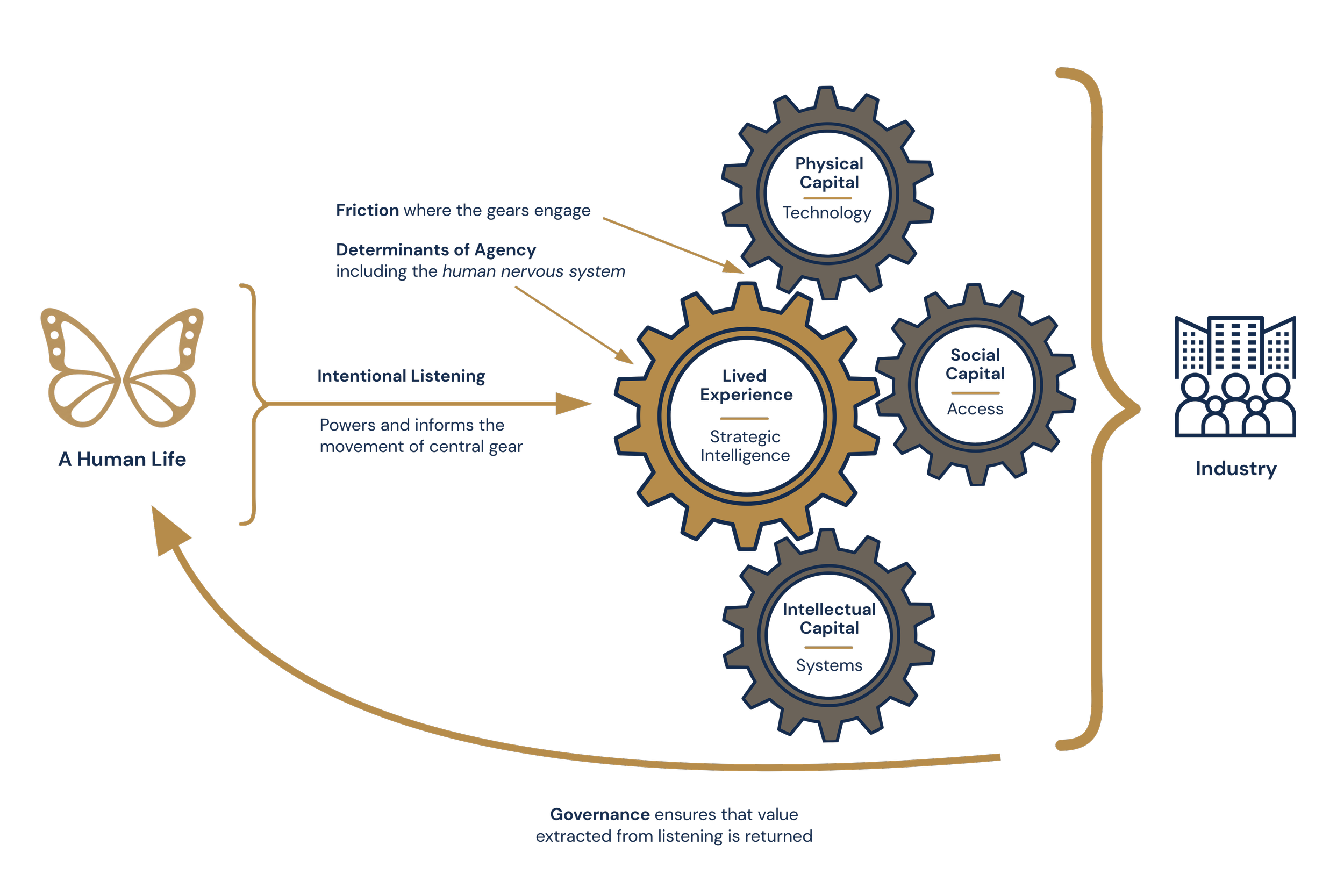
Caption: The Monarch Model™. Lived experience, as strategic intelligence, is the central gear that drives the three forms of capital it meshes with: physical capital (technology), social capital (access), and intellectual capital (systems).
Source: The Monarch Model™, Monarch Futures analysis.
Exhibit 2. Lived experience, as strategic intelligence, is the central gear that drives the three forms of capital it meshes with.
● Central gear: Lived Experience (Strategic Intelligence)
● The three forms of capital it drives: Physical Capital (Technology); Social Capital (Access); Intellectual Capital (Systems)
● Endpoints: A Human Life (left) drives toward Industry (right)
● Intentional Listening: powers and informs the movement of the central gear
● Friction: occurs where the gears engage
● Determinants of Agency: including the human nervous system, are where the teeth mesh
● Governance: ensures that value extracted from listening is returned
The work begins with intentional listening, by drawing out what patients and caregivers carry so that what gets built is informed by a real human life rather than an organization’s assumptions about one.
The listening that powers this gear is a discipline, the engine inside the engine. It operates on the safety-first principle described earlier, assuming a strained nervous system rather than a regulated one, because a method that does not first establish safety cannot produce insight that is true enough to build from. Through listening, the determinants of agency become visible. They form the teeth of the central gear, allowing lived experience to engage the rest of the model as strategic intelligence. Nothing in the model moves unless this central gear turns first.
Intentional listening is the practice of gathering, interpreting, and validating stories, observations, and lived experiences through a spectrum of methods and channels to understand the comprehensive human context surrounding healthcare decisions. Listening takes many forms, and the model is intentionally agnostic about which. It can happen through a patient and family advisory council, an engagement with a patient advocacy group, a one-on-one interview, a focus group, or the slower work of sitting with a single family. It can also happen at a much larger scale. Large language models (LLMs) can now hold thousands of individual accounts at once and surface what recurs across them without dissolving any one of them into an average.
Intentional listening is the practice of gathering stories from multiple sources and synthesizing what they hold into insights specific enough to build from. Intelligence emerges from multiple human-scale sources. An advisory council, an interview, a social signal, and a platform reading across thousands of accounts each reveal something different. Together they produce a richer understanding than any one source can provide, because each catches what the others miss and none can be trusted alone. What gets built from that synthesis is then tested where it must hold, against a real-world patient scenario rather than a hypothetical one. A use case that survives contact with an actual life is the only kind worth building on. AI can widen the scale of listening enormously, but it cannot stand in for the life on the other end of it.
Because listening draws on real lives, it carries an obligation to the people who live them. A story offered in confidence is not raw material to be mined and set aside once insight has been gained. It is the contribution of a person who trusted the organization with something true about their life, and that trust sets the terms for what follows. Listening well is a form of stewardship. It asks for consent that is informed rather than assumed, protects what people share rather than treating it as a resource the organization now owns, and requires the value created from that intelligence to return to the lives that made it possible. Reciprocity is not an aspiration layered onto the model after the fact. It is the expected direction of value, and governance is what makes that return durable.
Governance is the systemic mechanism that ensures value is returned consistently, accountably, and economically rather than occasionally or incidentally. Governance belongs to listening rather than to any single form of capital because it establishes the terms on which lived experience enters the model and the terms on which the value created from it returns. The obligation grows sharper, not softer, as the scale of listening expands. When a platform can read across thousands of accounts at once, the distance between the person and the decision widens, and the duty to honor the source of that intelligence widens with it.
Lived experience is strategic intelligence. The people who provide it are not subjects of the innovation built from it but its authors, and the Monarch Model treats them accordingly. Nothing else in the model moves until lived experience is engaged deeply enough to turn the central gear.
The Three Forms of Capital
The determinants of agency transform lived experience from personal story into strategic intelligence. Like the teeth of a gear, they give lived experience the ability to engage with the systems around it. Listening reveals those determinants, making agency visible and actionable.
As the central gear turns, it engages the three forms of capital within the solution being designed or evaluated: physical, social, and intellectual capital. Each form of capital meshes with the same determinants of agency, allowing lived experience to shape how the solution is designed, implemented, and improved.
Physical capital in the Monarch Model consists of the technology and physical environments through which lived experience unfolds. Physical capital is the accumulated value embodied in the physical and technological infrastructure that enables healthcare delivery. Physical capital is the tangible scaffolding experience can draw on: the platforms, tools, devices, spaces, architecture, and technical capabilities available to it, from media and channels to artificial intelligence, interoperability between systems, sensors and tracking, clinical environments, built spaces, and the data infrastructure underneath all of it. The line between the built environment and technology is itself dissolving as sensors, smart devices, and responsive systems become ambient, the room becomes a sort of device, and the building becomes part of the technology.
This is why physical capital holds the environment and technology as one. Physical capital asks what is materially and technically possible, and its discipline is choosing the capability, environment, or design that fits the life rather than reaching for the most sophisticated option on the shelf, because the right solution is sometimes a great deal of technology and sometimes almost none. It is the means of building, reaching, and shaping experience. Physical capital meets a life at cognitive load and executive function, at whether a person has the capacity to learn an interface, follow a sequence, or operate a device under the conditions they are in.
Social capital in the Monarch Model consists of access, an experience often measured by equity today. Access determines whether the solution reaches the person it is intended to engage, or only the people who were already easy to reach. Social capital governs access in the most comprehensive sense, not only whether care is offered but whether it arrives across the distance of a life.
Industry often recognizes the value of access through “patient access” but this gear expresses something more dynamic. Social capital is the accumulated value embodied in relationships, communication, trust, behaviors, and cultural norms that shape how people experience healthcare. Some of that distance lives inside the message, in health literacy, in cultural framing, in whether communication reaches people in the language and dialect they speak. Some of it lives outside the message entirely, in whether a person has reliable internet, a way to get to an appointment, or the bandwidth to act at all, the social conditions that decide whether anything offered can be used. The temptation is to call this messaging, because messaging is how it shows up, but messaging is only the surface. The real question is reach with equity as its measure: whether the solution connects to everyone it is meant for or stops at the edge of the people who were never the hardest to serve. Social capital meets a life at language, health literacy, transportation, social support, and bandwidth, the determinants that decide whether anything offered can be received.
Intellectual capital in the Monarch Model consists of the systems that experience informs and the information economy central to healthcare delivery. Intellectual capital is the accumulated value embodied in clinical knowledge, evidence, standards, and organizational learning that informs healthcare decisions and innovation. Intellectual capital is how the field thinks, decides, and moves: its knowledge, like care plans or the questions a clinical trial is built to answer; its incentives and waiver programs; how dollars flow, and how time is prioritized and allocated. Champion and advocate networks belong here, because a trusted person handing something to another person is not a channel. It is a web of relationships, incentives, and credibility, and it is often the difference between a good idea that circulates and a good idea that moves.
Intellectual capital meets a life at administrative burden, financial strain, trust, and caregiver capacity, the determinants produced when the field’s rules, incentives, and knowledge press against the person living under them.
Designing with Friction
The Monarch Model is drawn as interlocking gears because gears transmit motion only where their teeth meet. A gear that does not mesh can spin as quickly and elegantly as it likes, but it cannot move anything beyond itself. Motion exists only at the point of engagement, where one gear presses against another and force is transferred. The same is true of healthcare innovation. Movement does not happen in strategy documents, governance committees, or technology roadmaps in isolation. It happens where lived experience presses against technology, access, and systems, where the realities of a human life meet the resources an organization chooses to invest in it.
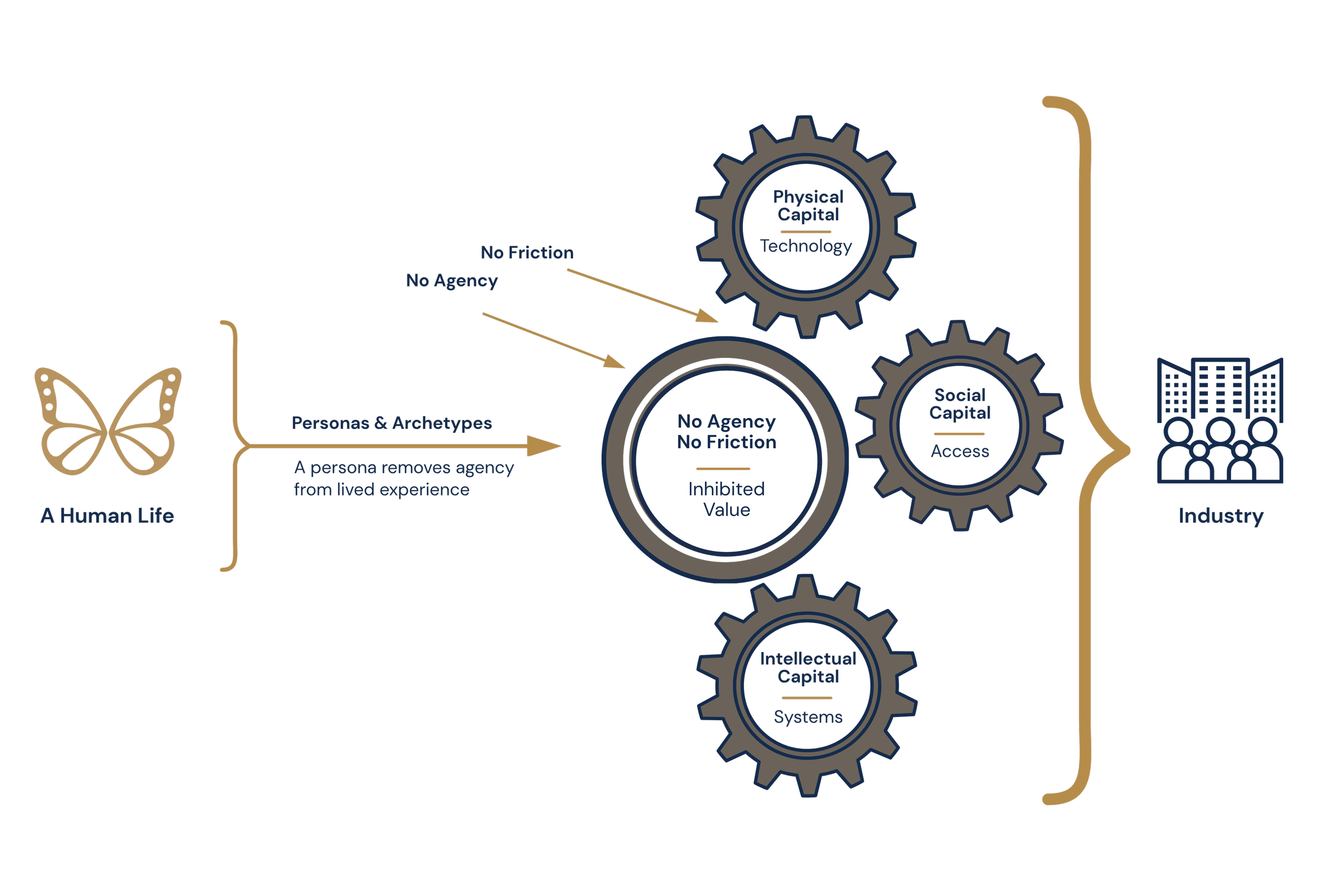
Caption: Lived experience abstracted, with agency removed. The driving gear can no longer meaningfully engage any form of capital, limiting the value it can create.
Source: The Monarch Model™, Monarch Futures analysis.
Exhibit 3. Strip agency from lived experience, and the driving gear can no longer engage any form of capital.
● Central gear: No Agency, No Friction (Inhibited Value)
● The three forms of capital, now disengaged: Physical Capital (Technology); Social Capital (Access); Intellectual Capital (Systems)
● Endpoints: A Human Life (left); Industry (right)
● Personas & Archetypes: a persona removes agency from lived experience, so the driving gear no longer meshes with any form of capital
The Monarch Model deliberately embraces those points of contact rather than smoothing them away because they are where organizations learn. The teeth of the central gear are the determinants of agency. They are the specific places where each form of capital meets a human life: technology at cognitive load and executive function; access at language, health literacy, transportation, and social support; systems at administrative burden, financial strain, trust, and caregiver capacity. These determinants are not conditions surrounding engagement. They are the engagement itself, the only places where lived experience can transmit motion to the rest of the model.
Where teeth meet, friction follows, and most organizations have been taught to interpret friction as evidence that something has gone wrong. The Monarch Model treats it differently. Friction is the resistance, or lack thereof, that occurs where lived experience engages physical, social, or intellectual capital. Friction is diagnostic because it reveals exactly where motion is being lost, where a design is working against the person rather than with them, and which determinant of agency is responsible. It is never simply dissatisfaction, resistance, or poor adoption. It is always friction at a named determinant, making the problem visible enough to identify, assess, and intentionally redesign. That distinction matters because not all friction should disappear. Some friction grinds, consuming effort while wearing down both people and systems, and that friction should be reduced wherever it appears. Another friction is productive. It is the necessary resistance through which lived experience transfers motion into organizational learning. Remove that friction in the name of efficiency, and the gears no longer engage. The system may become quieter, but it also stops being driven.
This is why disengagement is every bit as dangerous as excessive friction. Pull a gear away from the center and it still spins. Energy continues to be spent. Activity continues. The appearance of movement remains. Yet nothing is transmitted beyond the gear itself. Organizations do the same thing whenever they distance strategy from lived experience in pursuit of speed, efficiency, or scale. Meetings happen, technologies launch, dashboards improve, and every outward sign suggests progress. But if those decisions are no longer meshing with the realities of a human life, the organization mistakes motion for progress. The work is no longer connected to the people it exists to serve, and energy that might have produced value is instead dissipated into movement that goes nowhere.
The persona illustrates this failure mechanically. Premature abstraction begins with a living person and ends with something much easier to manage but much harder to move. Every simplification removes another point of contact until what remains is polished, coherent, and frictionless. It has all the qualities an organization prefers: clarity, consistency, predictability, and a journey that unfolds exactly as expected. What it no longer has are the teeth through which a real life transmits force. The conditions that once allowed lived experience to engage technology, access, and systems have been refined away in pursuit of simplicity. The persona therefore does not fail because it misrepresents reality, although it often does. It fails because it has been made too smooth to drive anything at all.
The same principle applies to the center of the model itself. Human agency is not merely one of healthcare’s desired outcomes; it is part of the mechanism through which healthcare creates value. A life whose agency has been diminished by the system meant to serve it has fewer opportunities to engage with technology, access, and systems because the very teeth through which lived experience transmits motion have been worn away or invalidated. Listening alone cannot restore what the system has already eroded. A story can still be heard, but it has less capacity to move the organization because the conditions that once connected that life to meaningful action have been diminished.
When the gears engage well, however, value does not move in only one direction. Better technology, better access, and better systems expand a person’s agency, and greater agency produces richer lived experience the next time the organization listens. The model therefore becomes self-reinforcing, but only if governance ensures that the value created from lived experience consistently returns to the lives that generated it. Reciprocity cannot remain an aspiration entrusted to organizational goodwill. It requires a mechanism capable of making return as systematic as listening itself, because value that is not intentionally returned is value that organizations will eventually learn to keep.
The Monarch Model is therefore not a linear process but a continuous rotation. Lived experience remains the driving force. Through listening, the determinants of agency become visible where the teeth meet. Physical, social, and intellectual capital respond to what those determinants reveal, and governance ensures that the value created through that engagement returns to the life from which it originated. The cycle repeats not because the work has failed to finish but because human lives continue to change, and a model designed around living people must continue changing with them. That is why the Monarch Model is a discipline rather than a procedure. Procedures are designed to produce completion. Disciplines are designed to sustain attention. Organizations that finish the work eventually stop listening. The Monarch Model assumes the opposite. A human life at its center continues to change, and so the work of understanding it can never honestly be complete.
Applying the Monarch Model
Two cases where the technology-first instinct gets it wrong, and listening to lived experience reveals a simpler, more human solution.
Case Study: The Cooler
CASE AT A GLANCE
● The instinct: Manage two-household care coordination through an app or shared portal: a dashboard, automated reminders, and software syncing the two homes.
● The reframe: The real difficulty is physical, not digital: safely moving a temperature-sensitive medication between two stressed homes. The friction is the handoff and the storage, not the reminder.
● Determinants of agency: Cognitive load · Caregiver capacity & social support · Trust & authority
● The solution: A sturdy, lockable cooler that lives in both homes and on the road, with the schedule printed inside the lid and access governed by a physical code. No account, no app, no interface to learn.
Consider a problem that a technology-first instinct gets wrong almost every time.
A large share of children living with serious illness do not live in a single home. Divorce, separation, kinship care, and foster placement are ordinary realities, and yet prescriptions, durable medical equipment, patient portals, and even care delivery itself are still frequently designed around the opposite assumption: one two-parent household where everything lives in one place and in one set of hands. The standard instinct, when that dynamic is defined, is to manage that care coordination through an app or a portal by building a shared dashboard, a workflow to send reminders, and ultimately, synchronize the care between the two homes through software.
Start instead from lived experience, and a different problem surfaces. The real difficulty may not be memory nor coordination. It may be the physical logistics of moving a real, sometimes temperature- sensitive medication between two homes led by two stressed adults. The friction is in the handoff and the storage, not the reminder. An app does not address where the medication is physically stored, how it travels, or who is authorized to know the regimen.
Through the Monarch Model, a very different solution also becomes possible. Instead of a virtual dashboard, the most friction-optimized solution might be a sturdy, portable cooler that becomes the medication’s reliable home in both households and on the road between them. The medication schedule could be printed on the underside of the lid, so it’s available to any authorized adult who opens it, wherever they happen to be. The cooler might also lock, which helps govern access to protected health information through a physical code that authorized adults and private duty nurses can use, with no account to provision, no password to reset, no app to download, and no platform to learn. Access to the health information becomes inseparable from access to the medication itself, which is exactly where that access belongs.
Following the motion of all four gears and lived experience identifies the true problem: the handoff and the storage across two homes. Name the determinants at each contact and the diagnosis becomes precise.
Physical capital meets this life at cognitive load, because a portal asks two depleted adults to maintain an account, learn an interface, and reconcile a schedule across two households. The model instead reveals the capability that fits the life, which in this case is a durable object and a printed schedule rather than a screen (no batteries required).
Social capital meets this life at caregiver capacity and social support, at whether the second household can receive what the first one holds, and it creates access that reflects how the family functions rather than how the system assumes it does.
Intellectual capital meets this life at trust and authority, at who is permitted to know the regimen and who decides, and it aligns the design with the realities of caregiving and responsibility among the adults supporting the child. The persona of a single two-parent household had none of these teeth. That is why every solution built from it slides off.
No part of the solution requires an interface. All of the solutions require listening to lived experience first to arrive at the solution.
The cost of getting this wrong may not be explicit, but it is real. Coordination that breaks down can mean missed doses, or medications damaged in transit, which are not always simple to replace when a prior authorization stands between the family and a refill. Private duty nurses find their work impeded. And perhaps most notably, the patient and caregivers lose something harder to measure: the freedom to exercise their agency over how and where they spend their time, without the medication dictating it.
Case Study: The Phone Call
CASE AT A GLANCE
● The instinct: Refine the automated phone menu — shorten it, re-record the prompts in a warmer voice, add an option or layer in a callback feature or chatbot.
● The reframe: The menu itself is the friction. A frightened caregiver cannot perform executive function to navigate a routing tree to reach a single clinical judgment.
● Determinants of agency: · Cognitive load & executive function · Language & health literacy · Clinical judgment
● The solution: For established oncology families, remove the menu entirely: a line that reaches a person, or a guaranteed fast callback, with nothing to press.
The same instinct works where nothing physical is broken at all, but where the technology functions exactly as designed and still fails the person it was built for.
Consider a second problem: an oncology clinic invests in an automated phone system to route incoming calls. On its own terms the investment is sound, and it is the kind of upgrade any well-run practice would approve without a second thought: calls reach the right department, hold times fall, staff are freed from switchboard work, and the menu performs precisely as designed. The standard instinct, when callers struggle, is to refine the same system: shorten the menu, re-record the prompts in a warmer voice, add an option, layer in a callback feature or a chatbot that screens the symptom before a human is involved. Each of these treats the problem as one of routing, which is a problem operations teams know how to solve, and so the phone system that already exists becomes the thing that gets optimized.
Start instead from lived experience, and a different problem surfaces. Picture the caller. A parent dials the clinic after hours because their child is vomiting without a fever, and they need one thing: to reach an oncology nurse who can tell them whether this is a virus to manage at home or a reason to be seen in the emergency department tonight. They are not calling from a regulated nervous system. They are afraid. They are calling the oncology clinic, which means they are already carrying the one fear that number carries for every family on its list, and the question underneath their question is not really about vomiting.
The system answers the inbound call with a list of options read aloud: “press three for billing, press four for the nursing line”. But for the parent who is afraid, the numbers do not land. In that state they cannot hear a menu, and some may hang up before reaching anyone at all, and call again, and hang up again. The real difficulty is neither the length of the menu nor the warmth of the recording. It is that the system has placed a cognitive toll booth between a frightened caregiver and a single clinical judgment and is collecting that toll at the precise moment the caregiver is least able to pay it. The failure point is the menu standing between the caller and the nurse, not the wording of the menu. A better-worded menu is still a menu, and it still asks a human being with a depleted nervous system to perform executive function as the price of reaching help.
Approached through the Monarch Model, a very different solution becomes possible, and like the cooler, it requires less technology rather than more. The fitting physical capital is the phone already in the caller’s hand, with the smallest possible system behind it: a line for established oncology families that reaches a person, or a guaranteed fast callback, where the default is to stay on the line and a nurse will answer, with nothing to press. The auditory menu is removed from the front of the most clinically sensitive calls entirely, because the person calling that number is, by definition, among those least able to use it. The interface is not improved; it is taken away, because the right amount of interface here is none.
Following the motion of all four gears and lived experience identifies the true problem: a frightened caregiver needs to reach a single human judgment, and everything about the menu is friction between them and the answer they need. The determinants are visible at every contact.
Physical capital meets this life at cognitive load and executive function, and the menu demands both at the precise moment neither is available. It selects the capability that fits the life, which in this case is the phone the caller already holds and a line that reaches a person, rather than a smarter system that routes them better.
Social capital meets this life at language and health literacy, and it asks whether that path crosses the distance of a real life: to the parent whose first language is not English, to the hypervigilant brain that cannot hold three routing numbers at once, to the family that quietly stops calling after one too many calls went nowhere. The menu silently sorts families by who can navigate it, and the ones it filters out are the ones the clinic most needs to reach.
Intellectual capital recognizes the clinic’s most valuable asset for what it is: the nurse’s clinical judgment, the trained capacity to turn one symptom and one history into a single decision of come in or stay home, currently buried behind a layer of technology built to ration access to it rather than to deliver it. The friction in this case identifies a distinction the menu gets exactly backward. The keypad it demands, a working touchpad and the presence of mind to press it correctly under duress, is not capital the caller should have to bring; it is a toll the system imposes, and it is the grinding friction to remove. The nurse’s judgment is the friction worth protecting, because it is the entire reason the call exists, and a chatbot that resolved the call without ever reaching a nurse would be relieving exactly the friction that drives the care. The reframe relieves the first by moving its weight onto the provider, where the responsibility to reduce friction belongs, and never relieves the second. None of it requires a better interface. All of it requires listening to lived experience first.
There is a cost to the health system for not getting this right. If it is determined that the patient could have had the symptoms managed at home, but the frightened caregiver cannot get past the phone menu to the answer they need to triage appropriately, they may end up coming into the hospital anyway. That cost then compounds: a likely immunocompromised patient is now potentially exposed to infectious disease, the hospital has a bed occupied that another patient could have used, insurance and the family are charged for the encounter, and everyone ends up spending more resources, physical, social, and intellectual, than the problem initially required.
An Invitation
Every element of the model points toward a single act: to begin with a real human life rather than an imagined one.
Every element of the Monarch Model points toward a single act: to begin. Not with a roadmap or a persona, nor with a workshop, a dashboard, or a framework to be completed, but with the irreducible reality of a human life.
The place to begin may be a question about when to refer someone to palliative care, a conversation with a family trying to understand private duty nursing, the design of a product, the reshaping of a workflow, the evaluation of an investment, or the repair of an experience that has quietly failed the people it was meant to serve. Even if the use case changes, the invitation does not. Whatever the work, the first responsibility is to see it through the lived experience of the person whose life it intends to affect.
That is why the Monarch Model resists becoming a method. Methods eventually become routines, routines become assumptions, and assumptions have a way of replacing the very curiosity they were meant to cultivate. The model offers something less prescriptive but ultimately more demanding: a discipline of attention. It asks that before we organize the problem, we encounter the person; before we optimize the system, we understand the life that must live within it.
Sometimes that person we must listen to is already in the room. Often, they are not. When they are absent, the absence is not an inconvenience to overcome but the first meaningful finding. It tells us that we are preparing to make decisions about a life we have not yet taken the time to know. The appropriate response is not another meeting or another brainstorming session. It is to go and listen. How that listening happens is deliberately undefined. Listening may take the form of a conversation across a kitchen table, a day spent shadowing a clinician, an afternoon with a caregiver whose routines have been shaped by circumstances no workflow diagram has ever captured, or a quiet hour with someone whose experience has never before been treated as expertise. The Monarch Model does not prescribe the technique because listening is not a technique. It is a posture, one that asks for patience, humility, and the willingness to discover that the problem was never quite what we assumed it to be.
What listening produces is not certainty but discernment. It leaves us with better questions than the ones we arrived with and a clearer understanding of what we still need to learn before any solution deserves to move from hypothesis to reality. In that sense, listening is not the work that precedes design; it is design in its earliest and most consequential form. Every meaningful innovation begins not with an idea waiting to be built, but with a life waiting to be understood.
A Migration Finished Across Generations
Building healthcare from lived experience is generational work, a legacy built for the human at its center and carried forward.
The monarch butterfly does not complete its own migration. The journey is finished across generations, each one carrying the work farther toward a place it will never personally reach, navigating by an inherited sense of where it is going and trusting the next generation to carry it the rest of the way. Building healthcare from lived experience is work of exactly that kind. The families whose stories become the blueprint will not all be present for the system those stories make possible, and they were never meant to be. What they carried becomes the thing the next design is built from, and the one after that. That is what it means to treat story as strategic intelligence, and to hold off on abstraction until abstraction can rise from a real life. It is generational work, and it is the work the Monarch Model exists to make ordinary and expected.
The Monarch Model exists to ensure that as healthcare changes, human agency remains present in the systems built to serve it. Lived experience is how that agency stays visible, and how organizations discover what their metrics, dashboards, and planning processes cannot. It is how organizations learn where well-being is supported, where it is constrained, and where innovation must act. The future of healthcare will be shaped by the decisions that get automated, the agency that is supported, the outcomes that get measured, and the choices placed in the hands of the people the system serves. The question is whether those systems are built from assumptions about human lives, or from the lived experience of the people who have to navigate them.
The monarch never sees the end of its own journey, and it was never meant to. The point was always the generations it carried and the place they would one day reach. So it is with this work. This is legacy work. It is built for the human at its center, whose life gives the journey its purpose, and carried forward hand to hand by everyone willing to begin with that life and trust the next to take it farther than they could.
Before any persona is drawn or any roadmap is set, there is a more fundamental question worth sitting with. What does this person need in order to take a meaningful part in the decisions that affect their life, and has anyone taken the time to understand that reality yet?
There is only one honest place to begin: with the human.
A Letter to the Reader
To consider a perspective like the Monarch Model is to be willing to question how we do our work, why we do it, and what we treat as important. That willingness is rare, and it is demanding, but it is exactly where systemic change begins. Thank you for taking the time and care to consider this possibility. I have spent the better part of my career learning to communicate with and for people I had studied but never lived alongside. I helped engineers communicate the complexity of their ideas. I helped entrepreneurs pitch innovation to investors. I supported executives preparing for media interviews. I thought I understood patient empowerment, patient data ownership, and community engagement. I was good at it, too. And for a long time that was enough.
But then I became the patient searching for answers, and the mother holding her child through tears for one more moment before handing him off for a surgery that held no promise of a good outcome. I watched the systems I had helped explain to the world fail the people they were built for, including my own family, at the exact moments they were supposed to hold us. I learned that the distance between a well-designed system and a human being in crisis is not a small gap to close later. It is the whole problem.
I did not develop the Monarch Model to explain what happened to my family or to criticize the healthcare system. I designed it because we are standing at a rare opening, one I have been watching for the past decade. The tools arriving now are powerful enough to widen that distance faster than anything before them, or to close it in ways we have never been able to before. Which future we build is not up to the technology. It depends on whether the people building it begin with a real human life or an imagined one.
My hope is that the next family holding their child through tears at three o’clock in the morning meets a system built with them in mind, not one that learns who they are and what matters to them too late. My hope is that lived experience is treated as the strategic intelligence it truly is. These are the questions the Monarch Model exists to answer. And I hope what emerges outlasts me, carried by people who never met me and never needed to, the way the monarch trusts the next generation to finish the flight.
So, we must begin with the human. Everything I have lived, and everything I have learned, tells me that what we build next depends on it.
— Erica
About the Author
Erica V. Olenski, BCPA, CPXP, eFACHDM, is the creator of the Monarch Model and founder of Monarch Futures, a strategic advisory firm focused on helping healthcare organizations integrate the determinants of agency into organizational strategy, innovation, and system design. A healthcare strategist, executive communications leader, and patient advocate with nearly two decades of experience, she advises health systems, healthcare technology companies, public-private initiatives, and healthcare innovators on organizational change, digital transformation, health policy, patient experience, and strategic communications.
Before founding Monarch Futures, Olenski built her career leading corporate communications, public relations, media relations, investor relations, executive thought leadership, and healthcare strategy for organizations across the healthcare ecosystem. Earlier in her career, she founded #HITsm, one of the earliest cross-sector communities in healthcare social media, bringing together clinicians, patients, caregivers, policymakers, entrepreneurs, and health IT leaders to advance conversations about interoperability, innovation, and the future of healthcare.
A Board Certified Patient Advocate, Certified Patient Experience Professional, and Executive Fellow of the American College of Health Data Management, Olenski serves in global leadership and advisory roles advancing patient-centered innovation, health data strategy, healthcare technology, and systems transformation. Her work spans executive strategy, communications, policy, governance, and implementation, with a focus on helping organizations better integrate lived experience into decision-making and organizational design.
She is the founder of August’s Artists, a 501(c)(3) nonprofit advancing trauma-informed, family-centered care through art, advocacy, and healthcare communications, and co-founder of August Crossing, an initiative developing the first pediatric inpatient hospice in North Texas. Both initiatives reflect the practical application of the Monarch Model’s principles to nonprofit leadership, healthcare communications, and care design.
A frequent international keynote speaker, Olenski writes and speaks on healthcare strategy, organizational design, trauma-informed leadership, patient experience, and the determinants of agency. Through the Monarch Model, she seeks to provide healthcare with a practical framework and shared language for designing systems that better support human agency, meaningful participation, and the pursuit of health and well-being.
References
Suggested citation: Olenski EV. The Monarch Model™: Lived Experience as Strategic Intelligence. Monarch Futures; 2026. https://www.monarchfutures.com/monarchmodel. Accessed [date].
1. Welzel C, Inglehart R. Agency, Values, and Well-Being: A Human Development Model. https://pmc.ncbi.nlm.nih.gov/articles/PMC2848347/. Accessed June 1, 2026.
2. Salgo v. Leland Stanford Jr. University Board of Trustees, 154 Cal. App. 2d 560 (1957). https://law.justia.com/cases/california/court-of-appeal/2d/154/560.html. Accessed July 23, 2026.
3. Beauchamp TL, Childress JF. Principles of Biomedical Ethics: Marking Its Fortieth Anniversary. Am J Bioeth; 2019. https://www.tandfonline.com/doi/full/10.1080/15265161.2019.1665402. Accessed July 23, 2026.
4. Fiore JA, Sisko AM, Poisal JA, et al. National Health Expenditure Projections, 2025–34: Strong Utilization Growth Initially, Legislative Impacts Later. Health Affairs; 2026.
https://www.healthaffairs.org/doi/10.1377/hlthaff.2026.00642. Accessed July 10, 2026.
5. Centers for Medicare & Medicaid Services. National Health Expenditure Data: Projected. CMS; 2026. https://www.cms.gov/data-research/statistics-trends-and-reports/national-health-expenditure- data/projected. Accessed July 10, 2026.
6. Arnsten AFT. Stress signalling pathways that impair prefrontal cortex structure and function. Nat Rev Neurosci; 2009. https://pmc.ncbi.nlm.nih.gov/articles/PMC2907136/. Accessed July 10, 2026.
7. Administration for Children and Families. Executive Function. ACF Trauma Toolkit. https://acf.gov/trauma-toolkit/executive-function. Accessed March 1, 2026.
8. Herman JL. Trauma and Recovery. Basic Books; 1992.
9. Silicon Valley Bank. Healthcare Investments and Exits: H1 2026 Report. Silicon Valley Bank; 2026. https://www.svb.com/trends-insights/reports/healthcare-investments-and-exits/. Accessed June 1, 2026.
10. American Medical Association. AMA survey: prior authorization reform pledge falls short with physicians. AMA; May 13, 2026. https://www.ama-assn.org/press-center/ama-press-releases/ama-survey-prior-authorization-reform-pledge-falls-short-physicians. Accessed July 10, 2026.
11. Dean W, Talbot S, Dean A. Reframing Clinician Distress: Moral Injury Not Burnout. Fed Pract; 2019. https://pmc.ncbi.nlm.nih.gov/articles/PMC6752815/. Accessed July 10, 2026.
12. Schulz R, Beach SR. Caregiving as a risk factor for mortality: the Caregiver Health Effects Study. JAMA; 1999. https://pubmed.ncbi.nlm.nih.gov/10605972/. Accessed June 1, 2026.
13. Rodakowski J, Rocco P, Ortiz M, Folb B, Schulz R. Caregiver Integration During Discharge Planning for Older Adults to Reduce Resource Use: A Meta-analysis. https://epublications.marquette.edu/polisci_fac/55/. Accessed June 1, 2026.
14. Leavitt HJ. Applied Organizational Change in Industry: Structural, Technical, and Human Approaches. Carnegie Institute of Technology; 1962. https://collections.uakron.edu/digital/collection/p15960coll1/id/21949/. Accessed June 1, 2026.
15. Nundy S, Cooper LA, Mate KS. The Quintuple Aim for Health Care Improvement: A New Imperative to Advance Health Equity. JAMA; 2022. https://jamanetwork.com/journals/jama/article-abstract/2788483. Accessed June 1, 2026.
16. Institute for Healthcare Improvement. The Triple Aim: Care, Health, and Cost. IHI; 2008. https://www.ihi.org/library/topics/triple-aim. Accessed June 1, 2026.